Revisiting The Library

by Ella Potter

Throughout my childhood–especially during my middle school years–my family and I would go to the Horry County Memorial Library every week like clockwork. I walked through the automatic sliding glass doors– perpetually stickered with flyers for community events–and immediately felt the shocking chill of the AC, having escaped the thick heat of Surfside Beach. Each week we stepped into the building–my mom, sisters, and me, with a densely-packed tote bag of books hanging from my shoulder, which I’d always asked to carry. It was a thrill to step towards the circulation desk, open that small, silver door under the counter, and watch the books disappear from the bag on my shoulder into that black void–savoring the sound of each heavy thunk against the metal bottom
of the collection bin.
My mom, most likely relishing the quiet of the library, would then make her way towards the nearest plush seat to relax as my sisters and I ran to our favorite sections. While my sisters adored the seemingly-infinite collection of children’s books, for me, it was always the small room nestled in the back of the library which housed the young adult section that called to me. There was an endless selection of sub-genres, creating a multitude of options that never felt overwhelming as it truly never felt possible to make a wrong decision. The process of choosing a book only involved picking it up, looking at the cover, and reading the inner flap of the dust jacket. The only influences on my decisions was my own mind and my own taste–my own mental algorithm. Years later, my long-loved hobby of reading has still yet to fade.
I distinctly remember experiencing the meteoric rise in the popularity of reading in 2020, with the rise of BookTok during the COVID-19 pandemic. One of my favorite hobbies–that had been labeled as a nerdy interest and relegated to smaller, more niche communities on platforms such as Pinterest and Tumblr–had abruptly experienced an overwhelming amount of exponential growth in people talking about all things books on, seemingly, all platforms. Those who had no previous interest in reading, those who attempted an interest in reading as children but ultimately failed, or those who had long let go of the hobby and had considered returning, now had the easiest access to a wealth of bookish content and recommendations that had never been experienced before, in a time with an equal wealth in free–time while quarantined at home.
The rise of BookTok–and the subsequent increase in the popularity of other platforms like Bookstagram and BookTube–has been positive in many respects, giving the world a much-needed shot in the arm. The online hype surrounding reading has helped bookstore chains such as Barnes and Noble to stay in business after years of declining sales. Indie authors have been provided more accessible avenues for publishing and marketing their books, giving them the option to avoid traditional publishing routes–which are notoriously predatory, exploitative, and difficult to immerse themselves within. Most notably, the online hype for reading has introduced books to a wider audience, cementing itself as a socially-acceptable hobby no longer reserved for outcasts and nerds. So many positive aspects of the increasing popularization of books and discussion of reading would give the average person the impression of good, positive change, however, that may not be the case.

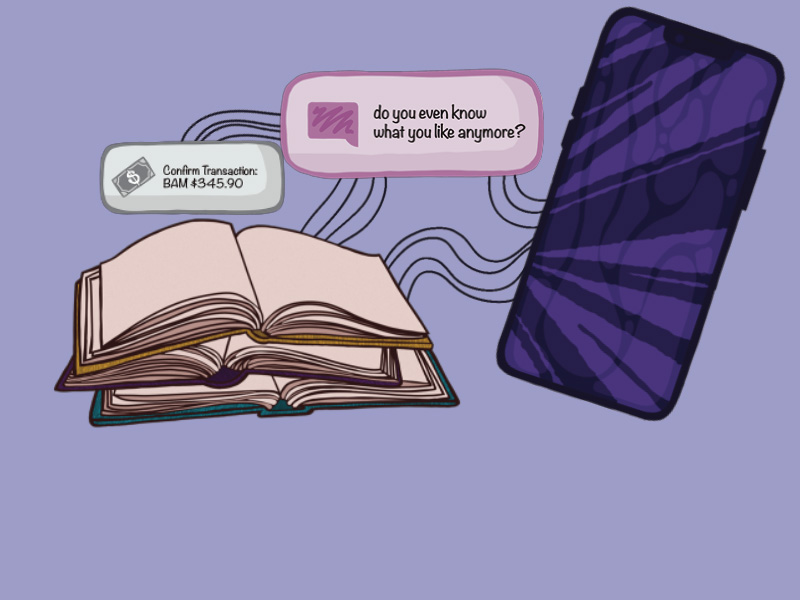
I’ve spent plenty of time in these online spaces since their conception and have consequently been influenced to buy and read titles because of them. I have not been immune to the consumption that comes as a package deal with these spaces–the same consumption which drives content creators and regular readers to have massive, ever-growing personal libraries or long lists of physical books ‘to be read’, or TBRs. I’ve spent more money on books in recent years than I ever have, while simultaneously spending less and less time at the library, finding myself opting to plan exactly what I want to buy before I ever step foot into a store rather than the intuitive wandering that library shelves had once inspired within me. Being increasingly online and being at the mercy of algorithms for book recommendations has fundamentally changed my decision-making process for picking my next read.
I’ve frequented the library often to study, as many students do, but for the first time in a while, I visited with the intent of choosing something to read without premeditation, as I did when I was younger. Walking back into my childhood library, I had expected to love the hunt–to feel the paper edges of well-worn and well-loved novels and feel compelled to an unexpected find. What I didn’t expect? Not only did I struggle to choose something, but I felt overwhelmed at the quantity of unfamiliar books around me, and ultimately felt that I needed a crutch in the form of my Goodreads list that I had compiled online, or a recommendation from someone that wasn’t me. My fingers were itching to pull my phone out of my back pocket and start looking for references, opinions, and recommendations instead of picking up the books that were actually in front of me to examine their covers and read their summaries. This is something that I had never experienced before I was routinely consuming an endless stream of opinions from strangers about which books are worth my time or not; many opinions that I might have disagreed with if not for the intense volume of them constantly filling my For You pages. The mental algorithm of my youth–which I used in full confidence, knowing exactly what I liked and what sounded appealing to me–had been shut down, replaced by the algorithms of internet spaces.
This is not only a book-centered problem. In an increasingly online world, we rely on social media algorithms more than we ever have before–from what recipes we should feed our loved ones, to which workouts will tone us in the most efficient way, to what clothes we think we should buy. There are certain positives to having a wider variety of options and access to what others are doing. People get to participate in trends and feel like part of a community. They bond over the newest trending book series, share theories about what will happen in the next book, and even bragging rights to say that they were there when the next hit or controversy happened. There are many possibilities for joy in these spaces–in moderation. When online voices and internet trends become the main source or determining factor for what people are consuming, individualism and personal agency begin to take a backseat. People may be pushed by the stream of culture and what everyone else online is reading or wearing, forgetting what they would actually choose for themselves if they weren’t being unconsciously pressured by what the newest trend had most recently framed as the correct thing to be doing.
Going back to the library has inspired me to return to how I used to find things before I used social media every day: by simply looking in front of me. Slowly, I’ve begun to find peace in shrugging off the constant flood of what the internet says I should read. I hope that every reader can once again find their love for reading in the paper pages of books–instead of the flat, cold scrolling of online reviews
and comment sections.