by Madisyn Small
The first time Caleb Merckle studied abroad, they’d left Japan feeling magnetized–as if they had to pull themself away from a plethora of experiences they had just missed so that they could return to their studies back in South Carolina. The next time they would leave Japan, their entire being would be altered after having their soul touched by the sanctity of lived religion unifying people across many cultures, social classes, and backgrounds. One festival filled with unexpected foreign embrace, a meshing of genuine curiosity and real humanity, and the equivalent of a “religious mosh pit,” would breathe new life into Caleb, cementing their perspective on how truly connected and full of love humans are.
Caleb’s natural and intense curiosity for the world, culture, and society had always been a strong part of them. Studying arts, history, and technology with Graphic Design while double-minoring in the deeply nuanced and historical Religious Studies and Asian Studies further confirmed Caleb’s passion to explore the world beyond their own. They had longed to experience the rich cultures and complex histories that they had studied for so long, and in May of 2023, a year before they would graduate, they were able to do so. Alongside many of the students in their class, the study abroad trip was their first time leaving the country, first time experiencing a new culture and place so intimately, and the first time they truly felt changed by an academic experience. Although they described their experience as, “somewhat shrouded by the veil of going to a new place for the first time,” they felt they had been truly informed and impacted by the trip, setting new sights on the future of their academic and life journeys.
Near the end of the study abroad trip, the group was entering Tokyo to soak in the final few days of their trip. Around the same time, in the small town of Asakusa in the Northeast section of Tokyo, the Sanja Matsuri Festival was beginning. The Sanja Matsuri Festival–or the Three Shrine Festival is an annual festival during the third weekend of May that synthesizes the Buddhist and Shinto religions. Millions of people–both local and foreign, as well as across many religions and cultures–come to pay their respect and honor the kami (spirit) enshrinements of Hinokuma Hamanari, Hinokuma Takenari, and Hajino Nakatomo: the three men who established the Buddhist Temple of Sensoji, as well as enjoy food stalls, play festival games, and experience traditional music, dancing, and story-telling alongside both the local Japanese and foreign visitors, as well as many yakuza members who reportedly run the festival–to some unknown degree–and take the festivities to relax and let loose away from their duties, showing off their tattoos, and drinking vivaciously amongst the crowd. Many people may also view fights that take place between members of different neighborhoods–a tradition of Sanji Matsuri since the beginning of the festival.
Before the festival begins, the head priest of the Asakusa Shrine performs a special ritual which moves the enshrined kami of the three founders of Senso-ji into three large shrines called mikoshi. A small, obscured door on each mikoshi is opened for the spirit of each founding man to reside within for the festival. On the first day of the festival–Friday–the Daigyorestu Parade procession of musicians, priests, geisha, and other participants wearing traditional Edo-period clothing travel through the city, before a few portable versions of the mikoshi are brought out and jostled through the streets as the festivities truly begin. The next day–Saturday–is dedicated to the blessing of around one-hundred more mikoshi through many ceremonies held at the Senso-ji Temple and the Asakusa Shrine, before women and children carry these small shrines of devotion throughout the neighborhood streets. On the final day–Sunday–the three main mikoshi shrines are brought out early in the day before people arrive to compete for the immense honor of carrying one of the shrines through the city. These competitions mostly consist of verbal and physical aggression, and safety for spectators is maintained through keeping their distance outside of the Sensoji gates. Afterwards, the three golden shrines are danced, vigorously shaken, and carried through the beautifully-decorated streets until night to bring prosperity and luck to the neighborhoods. This marks the ending of the weekend’s events, and the festival
begins to settle down.
The three-day festival is widely-known, with records of its celebrations and activities dating back to the 7th century with its present-day form being established during Japan’s Edo period (around 1600-1868). The Sanja Matsuri Festival is historically-celebrated and regarded as among the largest and most high-energy, chaotic events in the country, and Caleb’s class were going to miss the entire event.
In the time since the first trip, Caleb graduated with their Bachelor’s Degree and returned to Coastal Carolina University to pursue their Master’s Degree in Asian Studies, which they noted “always tends to reach into Religious Studies.” Caleb had found a specific area of interest in the concept of Lived Religion. Caleb explained that throughout history, authoritative and colonial powers were often quick to falsely interpret and label minority, religious, and ‘othered’ groups. This was especially glaring during the Third Reich in Nazi Germany, as the concepts of labeling, stereotyping, and harming people based on their religious beliefs was in one of its strongest eras and the immense harm of that practice flooded society. Most of these discriminatory actions were taken by people who never researched, experienced, or truly knew what these beliefs or practices were, they merely spread their opinions on others’ beliefs and allowed disinformation and hate to spread, and as most of the victims came from lesser-known or marginalized backgrounds, cultures, religions, and social classes, the perpetrators are never truly disciplined for their crimes. Ultimately, these limited views and false interpretations fell into the academic world with little to no pushback, leading to hundreds of years of discrimination mixing into real experiences, without any clear separation, perpetuating many of the
beliefs beyond their own time.
Caleb also explained how in general, the written records of religious beliefs in formal texts and the implied experiences may never capture the full truth of the religion–only how those cultures, traditions, and ideologies are perceived and remembered. Lived religion describes the actual experiences, expressions, and practice of faith and belief for the real people living them. Through studying both the reality and embodiment of religions as they actually exist–rather than how they are said to exist–creates an honest image of the experience of one’s faith. Caleb, and other students of lived religion, examine how the average, common person actually engages with their religion. This includes material aspects such as clothing, food, ceremonies, rituals, etc., as well as ideological aspects such as beliefs surrounding life and death, how a person interacts with their religion every day, the diversity within a given faith, and the traditional and untraditional aspects of each religion. The study of lived religions is essential to understanding how humans actually live their lives, process and understand their places in the world, and prove that we are all more alike than different, despite our varying beliefs. The harm and violence created by stereotyping and religious discrimination is everlasting, but lived religion has begun to recover and heal many cultures, religions, and people.
Becoming so deeply studied and aware of both the conception and significance of lived religion, Caleb’s interest in the Sanja Matsuri Festival they had missed never truly left their mind. Caleb explained to me how for the next year, they “practically begged on his hands and knees” for someone–anyone–to help them return to Japan. While their initial trip was beyond fulfilling and they had learned so much, they felt something was calling them to experience the Sanja Matsuri Festival, but they didn’t have the means of returning on their own. After trying and applying for different opportunities for funding, Caleb was eventually able to work with the Edwards College to partially fund their trip. In May of 2025, Caleb found themself in Asakusa, Japan with only a single colleague, Gabriel Austin, to discover the festival with. This created a very individualized, intimate experience between Caleb and all of the people they’d be meeting, and it would prove to be foundational to the experience they would have.
During the majority of the festival, Caleb interviewed a plethora of people to hear about themselves and their stories, but also to learn about the history of the neighborhoods’ cultures, people, and spirits, as well as the Sanja Matsuri Festival itself from firsthand accounts. They spoke with the Japanese locals who were setting up vendor stalls to recover the local economy following Golden Week–a week of tourist focus which the Sanja Matsuri Festival assists in economic restrengthening before the following summer–as well as members from different neighborhoods who were participants of the festival’s processions, other foreigners who had come to watch and participate where they could, and many people with vastly different stories to tell. After an initial nervousness, Caleb found that many of the Japanese locals they interviewed were actually quite excited to speak with Caleb–sharing their thoughts about the festivities, information about the history and traditions of the Sanja Matsuri, and a general energetic anticipation for the tourists to experience such a special tradition–with only a few speakers choosing to only share a few polite, respectful comments, before returning back to the festival. These conversations with the locals directly contrasted the xenophobic distance that many throughout history have labeled the Japanese as regarding foreigners with: a resentful and harmful stereotype Caleb was proud to see lived religion and culture disprove right before their eyes.
Caleb met many festival part-icipants who were not Japanese, including foreigners from Los Angeles, France, Africa, and many other places, as well as many people who had immigrated to Asakusa and nearby areas and had a unique perspective on the festival’s traditions and culture. While some people were only visiting for the bragging rights of attending what appears as the most chaotic and high energy party of the country, most people held true reverence and genuine feelings for the Japanese and the Sanja Matsuri while participating in the ethical tourism that such events highlighted. One person Caleb interviewed, a French man, spoke about how he had married a local Japanese woman from one of the nearby neighborhoods, but hadn’t yet been invited to the honor of being one of the mikoshi carriers during the festival. Caleb described the way the man’s eyes were practically illuminated as he described how he uses “his only day off [of work to participate in the festival and that] he takes this opportunity every year to [come] experience life with friends, neighbors, and family,” which was something that resonated deeply within Caleb and their own journey in returning to Japan that year. Caleb spoke with many other foreigners who shared a collective excitement and honor to be attending the festival, with very few people showing any neutrality to the event. These interviews consisted of their journeys to attending the festival, the overall welcome they had experienced in participating in the events as they progressively grew comfortable and let loose with the locals, as well as how spiritual and genuine the festival had been for them. It was clear that the Sanja Matsuri Festival was beyond any expectation anyone had imagined, and it was not only Caleb who felt magnetized to the festival.
It rained heavily throughout Saturday’s processions, but Caleb assured me that it did not halt or slow any of the day’s events. In the morning, they watched the day’s opening ceremonies and blessings of the mikoshi shrines before finding a place to watch the people carrying them throughout the town. They noted that the dancing and shaking of the mikoshi shrines actually intensified as the participants adore the rain and the rawness that comes with nature’s influence on the Sanja Matsuri. They also spoke with more festival attendees, including some members of the Yakuza, who had been within the crowds with Caleb, and they took in the hard work and care vendors had put into their stalls, food, and merchandise, which lined the streets and temple.
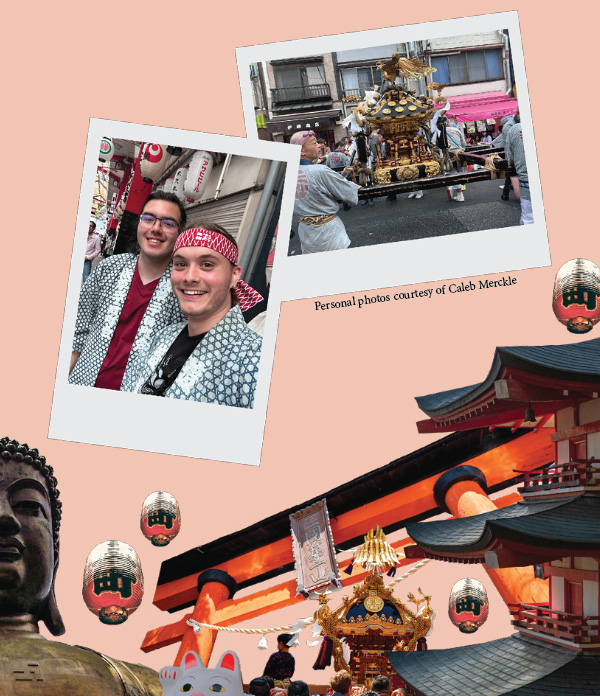
Sometime during Saturday’s festivities, Caleb met a bartender’s partner who–after seeing Caleb’s genuine interest in the festival–had stopped them in the middle of the street to invite them to join in Sunday’s events. After they agreed, she told them to arrive at the bar early in the morning as the mikoshi procession would be passing at 7 a.m. Caleb detailed how–alongside Gabriel–they took a thirty-minute taxi trip from where they were staying in Horikiri in Adachi to Senso-ji, walking in at 6:30 that morning, before the bartender’s partner walked in about twenty minutes later with slight surprise tracing her features as she greeted them. She dressed them both in traditional, hand-me-down garments for the festival, being sure to give them both a spare happi–festival jacket–she’d gathered for them. Caleb noted that they didn’t have any shoes for them to wear to the festival, so they’d participate without them–which they remarked was an interesting but grounding experience. At precisely 7 a.m., the mikoshi had reached the bar, and Caleb and Gabriel were thrown into the flood of bodies.
In the processions, Caleb des-cribed how the people moved as a unification of collected souls, holding onto one another and moving as one force to carry the elaborately decorated, golden mikoshi shrines. Each shrine weighed around a ton, requiring at least forty participants to carry one of the three primary shrines, shaking the shrine vigorously, ”like a sugar shaker,” to spread the kami’s energy onto the streets to revitalize the neighborhoods and bring good fortune and prosperity to the locals. Caleb described how amidst the crowd, the immensely sacred tradition was not merely spiritual–it grew tangible, emotional, and warm–even for those traveling alongside them who didn’t have as much of a grip, if any, of the mikoshi beams. All at once, Caleb felt hands push and pull them towards the front of the mikoshi procession, where they found themself under one the closest mikoshi, assisting in the honor of carrying and shaking the shrine through the neighborhood. As they told this part of their journey, I watched their eyes illuminate, much like the French man from their earlier story. Caleb told me how “you go into what is essentially this giant, religious mosh pit and you put your elbow under this massive beam and…[as] I was taller than most of the people there, [I was] just bearing this massive amount of the weight and it
hurts so bad, but, who cares, right?”
At this point in our conversation, I could see as Caleb’s eyes brightened and grew glossy, that they were no longer in the courtyard with me–they had been transported back to May 18th and into that mass of bodies, spirits, and energy. Remarking on his experience, I told them, “There seems to be so much humanity that you experienced–just souls being souls together–that is so beautiful.” Blinking away their moment back in Asakusa, Japan, they looked back at me and smiled, explaining how it was arduous and painful, but the joint spirit of the carrying and shaking makes it nearly effortless. They said, “That is the humanities, right? It is a sort of collection of individuals and souls and cultures. It’s a great demonstration of unity that goes beyond the cliches that we are all only one sort of thing or another–it demonstrates it–a real lived experience.”
I asked Caleb if they had ever experienced anything similar to the Sanja Matsuri Festival before that weekend, and they could not think of any physical example beyond their childhood church experiences, which were emotionally-charged, but still lacked the intensity of the religious experience they had found in the Sanja Matsuri. Having that experience of being embraced by culture so intimately, I asked them how their view of culture had shifted or manifested. They explained that in their eyes, “culture consists of mass forms of rituals and experiences related to religion, artistic expression, and identity. It can be perception-shattering, blissful, [as well as] the root of suffering for many. In many cases, cultural expression becomes an immaculate vehicle for growth and change in our world,” eloquently describing how nuanced and universal culture acts for many people in society–within both the resilient and silent, and the emotional and bold–and how deeply moved by the culture Caleb was after their experience in Asakusa.
After a few hours of carrying the enormous weight of the mikoshi with little food or water, Caleb and Gabriel stumbled back to the bar to return their borrowed clothing, have a delicious meal of ramen a few blocks down, and spend the day resting, relaxing, and thinking. Eventually, the energy of the festival procession caught up to them, and they wept alone, describing the energy as “overwhelming” and profound. They told me how almost every day since then, they have experienced “brief glimpses of the memories from [the Sanja Matsuri Festival] and the impact their time has had on their perspectives, heart, and mind, in that “the experience of being at the festival, participating, and observing had certainly transformed [them].” They continued to explain how they were not quite sure how the transformation will manifest itself later, but at this moment, they said, “I do know that there is a light behind people’s eyes. It’s bright and warm and full of awe. When I can view people without judgements on what I think the world should be like, they’re right here. You don’t have to go to Japan to find that though, I’ve experienced the same thing at a Jiffy Lube.” After a beat, they continued, “That might be the core of lived religion. It’s the fact that you can find people practicing everywhere, in every part of life, no matter the circumstance, no matter the type of faith–even with those who don’t belong to any religion. It’s something that no one–not the British Empire, the Nazis, or our modern powers–could
ever categorize in good faith.”
Inserting oneself into a setting, tradition, or moment you’ve never experienced can be overwhelmingly intimidating, but Caleb wants people to know that by entering that situation with respect, genuine interest, and an open mind changes everything–allowing for the most real experience and connection. Having experienced the profundity of real, lived religion alongside hundreds of strangers, bonded by genuine respect, passion, and reverence, Caleb was embraced by the Asakusa locals, having a lifetime of experiences within a single weekend and changing in many ways, forever. A few days later, after further email discussion with Caleb about more details from their experience at the festival, and personally struggling to write a conclusion that matched the profundity and sanctity of Caleb’s intense, raw, and spiritual experience, they wrote a final email to me where they eloquently declared: “I will return to the festival one day. To retrace my steps, celebrate the love of tradition, and, if I’m lucky, dance under the Mikoshi, again,” punctuating the emotionally-driven impact that words could never articulate,
only a second experience may.
Education
Abroad Information
Education/Study Abroad gives students opportunities to take accredited courses and internships all over the world, such as Japan, Ireland, Morocco, Costa Rica, France, China, and more–changing yearly!
Applications for the Spring Break and
Maymester programs for the following year typically open in August and close in mid-October.
Applications for the Study Abroad Programs for the following Summer are typically due in late-February, and International Summer Internships are typically due in early-April; both program applications are reviewed on a rolling basis.
Applications for the Fall programs for the following year typically open in late-October and close in mid-March.
All students are encouraged to attend Abroad 101 Information Sessions either online or in-person to learn more about the application processes for specific programs and scholarships–which offer students thousands of dollars in financial assistance.
Online information can be found on the Education Abroad webpage on the official Coastal Carolina University site, https://www.coastal.edu/educationabroad/.
Article based upon a 2025 interview with Graduate Student, Caleb Merckle.
External References
Japan Travel Guide – Events & Festivals,
Holiday in Japan – HotelTravel.Com, web.archive.org/web/20080706170637/www.hoteltravel.com/japan/guides/festivals.htm#sanja_matsuri.
Organization, Japan National Tourism.
“Sanja Festival: Travel Japan – Japan National Tourism Organization (Official Site).” Travel Japan, www.japan.travel/en/spot/1705/.
Collage images provided by Unsplash.